Jackie Kong, Esq.
Hawaii Divorce and Family Law Attorney
Call or click for a consultation
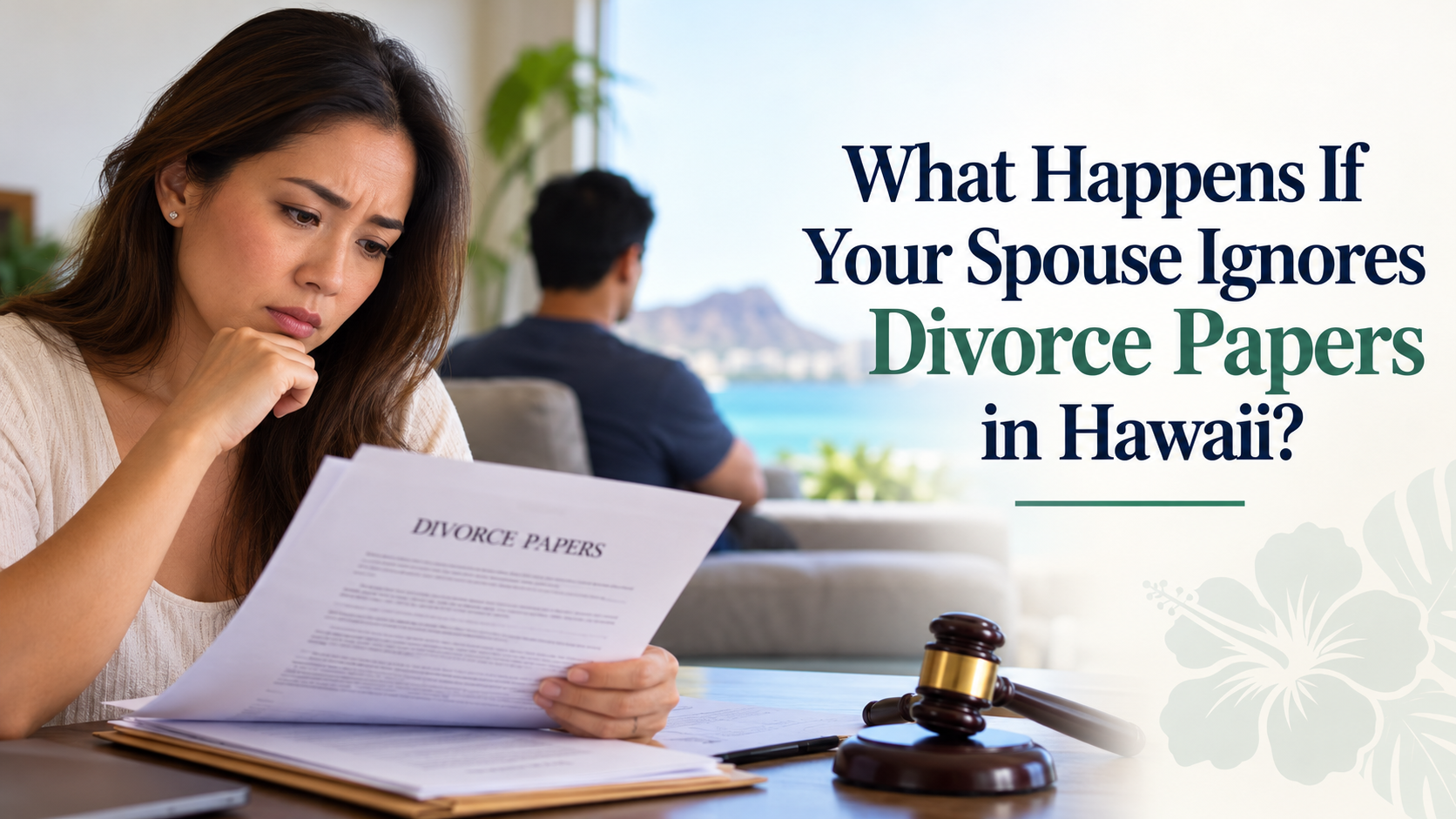
When you file for divorce, you may expect your spouse to respond, discuss the terms, or participate in the legal process. But what happens if your spouse receives the divorce papers and does nothing?
In Hawaii, a spouse’s failure to respond does not necessarily prevent a divorce from moving forward. Depending on the circumstances, the filing spouse may be able to request a default through the Family Court. However, the court must follow the applicable legal procedures before entering a default judgment.
Understanding what happens when a spouse ignores divorce papers in Hawaii can help you prepare for the next steps, avoid unnecessary delays, and understand when legal guidance may be beneficial.
When someone files for divorce, the other spouse must generally receive formal notice of the case. This process, known as service of process, gives the responding spouse an opportunity to participate and address the requests made in the divorce complaint.
A spouse may appear to ignore divorce papers in several ways. They might fail to file a written response, refuse to communicate about the divorce, or miss a scheduled court appearance.
These situations are not necessarily treated the same way. The court must consider whether the spouse was properly served and whether the required procedural steps have been followed.
For example, if your spouse was properly served with the divorce complaint but does not file a response within the applicable deadline, you may have grounds to pursue a default proceeding. If service was incomplete or legally insufficient, additional steps may be necessary.
The applicable response deadline depends on the court documents and the circumstances of the case. Hawaii’s standard divorce paperwork generally provides a 20-day period for the responding spouse to file a written answer after service.
The summons and documents served in your particular case should be reviewed carefully to confirm the applicable deadline and requirements.
If the response period passes without a response, do not assume that the divorce is automatically finalized. Instead, the filing spouse may need to complete additional paperwork and request the appropriate action from the court.
You can review the official Hawaii Judiciary divorce resources for information about divorce procedures and forms.
Yes, a divorce may be able to proceed through a default process if the legal requirements are satisfied.
Under Rule 55 of the Hawaii Family Court Rules, a court may enter a party’s default when that party has failed to plead or otherwise defend as required. The court may then proceed with a proof hearing when required and enter a default judgment if the applicable requirements are met.
However, default is a legal procedure, not an automatic divorce approval.
The court must have an adequate basis to determine that the responding spouse was properly served and failed to participate as required. Depending on the circumstances, the court may also require supporting documents, declarations, testimony, or a hearing before issuing a judgment.
You can review Rule 55 of the Hawaii Family Court Rules for the governing default provisions.
If your spouse has not responded, consider the following steps before deciding how to proceed.
Proper service is an important part of the divorce process. Keep copies of the service documents and confirm that the required proof of service has been filed with the court.
If your spouse was not properly served, the court may not be able to proceed with a default judgment. A qualified attorney can help you determine whether additional service steps are necessary.
Review the summons and the documents provided to your spouse. Confirm when service occurred and when the applicable response period expires.
Avoid relying on assumptions about when the deadline began. If there is uncertainty about service or timing, seek clarification before submitting a request for default.
The paperwork required to pursue a default divorce can vary depending on the case and the relief requested.
You may need to prepare financial disclosures, proposed divorce orders, declarations, or other documents required by the applicable court procedures. Cases involving minor children may require additional information concerning custody, parenting arrangements, and child support.
Check the instructions for your court circuit and the type of divorce you filed. Filing an incomplete packet can create additional work or delay the case.
Once the applicable requirements have been satisfied, you may be able to ask the court to enter a default and proceed toward a judgment.
The court will determine whether the procedural requirements have been met and whether additional evidence or a hearing is necessary. Follow any instructions or deadlines provided by the court.
If your case involves disputed property, support, custody, or other complicated issues, legal assistance may be particularly useful.
No. A spouse’s failure to respond does not guarantee that every request in the divorce complaint will be granted exactly as written.
The court must still follow the applicable legal requirements. It may need to review the proposed terms and supporting information before entering a judgment.
For example, requests concerning the division of property, spousal support, child custody, or child support may require appropriate documentation and consideration of the relevant legal standards.
When minor children are involved, the court must consider their best interests when making custody-related decisions. A default should not be treated as a guarantee that a particular parenting arrangement or financial outcome will be approved.
Preparing complete, accurate paperwork remains important even when the other spouse is not participating.
A missed response deadline does not necessarily mean that your spouse has permanently lost the opportunity to participate in the case.
Depending on the procedural status of the divorce, your spouse may seek permission to respond late or ask the court to set aside an entry of default or default judgment. Hawaii Family Court Rule 55 addresses setting aside defaults, while other applicable rules may govern the circumstances and deadlines.
The court will consider the relevant facts and legal requirements. The outcome depends on the circumstances, so you should not assume that a missed deadline guarantees an uncontested or final divorce.
If your spouse begins participating after you have started the default process, consider obtaining legal advice before taking further action.
A spouse may communicate about the divorce without filing the required court documents. For example, they might tell you that they disagree with the divorce, ask for more time, or discuss settlement terms while failing to submit a formal response.
Informal communication does not necessarily satisfy the court’s procedural requirements. At the same time, you should not assume that every failure to file a response permits an immediate default judgment.
Keep records of relevant communications and follow the court’s procedures. If your spouse is willing to negotiate, a settlement may still be possible, but any agreement must be properly documented and submitted for approval where required.
For a broader explanation of how divorce cases proceed, see our guide to the basics of divorce in Hawaii.
Consider consulting a Hawaii divorce attorney if:
An attorney can review the status of your case, explain the available procedural options, and help you understand what documentation may be required. The appropriate approach will depend on your circumstances and the current status of the court proceedings.
A spouse’s refusal to sign an agreement does not necessarily prevent a divorce from proceeding. The case may continue through the applicable court process, provided the legal requirements are satisfied. The next steps depend on whether your spouse has formally responded and whether the divorce terms are contested.
The standard Hawaii divorce summons generally provides a 20-day response period. If your spouse does not respond within the applicable deadline, you may be able to request a default. You must still follow the required procedures, and the court may require additional documents or a hearing.
No. A failure to respond does not automatically finalize the divorce. The filing spouse must follow the appropriate court procedures, and the court must determine whether the requirements for a default judgment have been satisfied.
In some circumstances, a spouse may ask the court to set aside an entry of default or a default judgment. Whether the court grants that request depends on the applicable rules and the facts of the case.
You may be able to handle certain procedural steps without an attorney, depending on the case. However, legal guidance can be valuable when service is disputed, the required paperwork is unclear, significant assets are involved, or custody and support issues must be resolved.
When a spouse ignores divorce papers, understanding the next procedural step can help you avoid unnecessary delays and prepare the appropriate documents.
The Law Practice of Jackie Kong assists individuals with divorce and related family law matters in Hawaii. If you are unsure how to proceed after your spouse has failed to respond, consider contacting the firm to discuss your circumstances and available legal options.
Contact The Law Practice of Jackie Kong to learn more about your divorce-related legal questions and the steps that may apply to your case.
Legal disclaimer: This article provides general information about Hawaii divorce procedures and is not legal advice. Court rules, filing requirements, and deadlines may vary according to the circumstances of a case. Consult a qualified Hawaii attorney regarding your specific situation.